
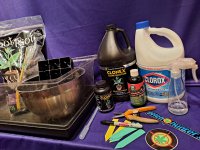
- Nursery tray
- Dome
- Large bowl
- Plug tray cells
- Plugs
- Rooting gel
- Nutes
- Bleach
- Green Cleaner (any IPM dunk)
- 90% Alcohol (in spray bottle)
- Scissors
- Tags
- Marker
- Pipette (5mL)
*Any rooting gel works. Any nute works, I’ve also left them out and still got roots. The Green Cleaner dip is optional.

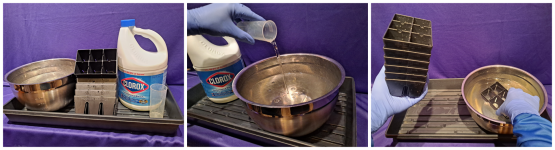
I have cell trays that are only used for root plugs so there’s no need to clean out crusted soil or stuck perlite from them. The trays get dunked a few times in bleach solution, shaken dry, and are ready for plugs.
1. Fill the bowl with your desired water volume (3L water pictured)
2. Add Bleach at a rate of
1 part Bleach to 100 parts Water (~35mL Bleach/gal Water) to achieve a strong sanitizing solution. I don’t usually measure this out. I add a splash of bleach to the water, but I measured out my “splash” and came to the rate stated.
3. Submerge each tray into the solution and lift allowing the solution to drain through the openings of the tray. Repeat this dunk and drain 3-5 times per tray until all trays are sanitized. Without rinsing the cell tray, return it to your nursery tray.

Here is where this clone procedure departs from the standard root plug process by introducing bleach into the soaking solution. I have experimented with the amount of bleach for years and have found that a wide range of concentrations is acceptable. There is a lower limit where there is not enough bleach and an upper limit where rooting is negatively affected but these limits are pretty wide. Another point to consider is the general rate of rooting for the cuts you’re working with. For instance, OG Kush tends to take longer to root than Skunk and would need a bleach concentration that would last longer than quicker rooting plants. For this, I would skew toward the higher end of the recommended bleach rate to ensure there is enough 'gas in the tank’ to get you where you want to go. You may also notice that I am
not pH-ing the solution and
not soaking the plugs for an extended period of time as I haven't found either to be necessary.
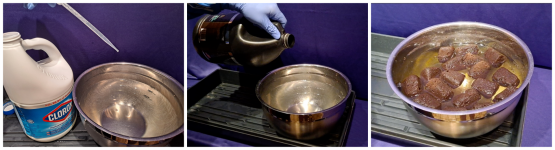
4. Rinse out your bowl containing the sanitizing solution from the above steps. Refill with fresh water to your desired volume.
5. Add between 12-20 drops of bleach per gallon of water and stir.
6. Add a splash of nutrients to the bleached water.
7. Add root plugs to the solution. Submerge each plug individually and squeeze out the air to fully absorb the solution (3-5 squeezes). Lift the plug from the solution and squeeze excess solution such that there is no dripping but the plug remains moist.
8. Fill the sanitized plug trays with prepared root plugs. I usually skip a cell in the tray to allow for room between cuts to mitigate any possible fungal issues between densely packed leaves in high humidity.

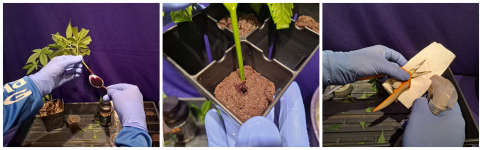
This is your standard process for choosing and preparing a cutting for the rooter plug. Choose a part of the plant that has a couple sets of leaves and allow for a node to be at the bottom of your cut. Trimming the leaves to reduce transpiration and overlap is a case by case call that depends on how densely packed the cuts will be and size of the cuttings. I usually include the IPM step of dunking the cuts in a general purpose pest mitigating solution as a ‘best practice’ step but is not necessary in the success of rooting.
9. Select the cutting of your plant that has a couple leaf sets and make your cut just below a node that gives you an overall clone length of about 5-7inches.
10. Cut the leaves from the lowest node while not gouging out the entire node from the stem.
11. Cut the lower portion of your branch at a 45 deg. angle about 0.5-1 inch below the lowest node. This ensures that the node will be within the root plug when inserted.
12. Trim any leaves as needed based on spacing and personal preference.
13. If using a pest mitigator (Pictured: Green Cleaner 3mL/gal): hold the cutting so that the lowest node and tip will not be submerged into the solution. Keeping the lower point of your cut dry will allow for better adhesion with the cloning gel.
14. Targeting the lower portion of the cutting including the lowest node, apply your rooting hormone. I roll the cut end in gel and roll against the wall of whatever I’m using to house the gel to remove excess (pictured: Spoon, but I’ve used shot glasses, etc.).
15. Plunge the gel’d cutting into the root plug. If the stem of your cutting is too narrow relative to the hole in the plug, just stab the plug to the side of the hole to make your own. This ensures a solid placement with good contact.
16. Make sure to add a tag with the plant name to the appropriate cells.
17. Spray the scissors with the 90% rubbing alcohol between plants.
18. Repeat steps 9-17 until all of the desired cuttings have been taken, plugged, and tagged.

Usually, you’ll read about having to baby the domed tray with opening the dome, adding heat mats on timers, special lighting, etc. but I take a
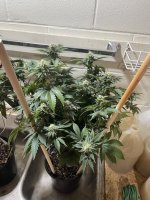
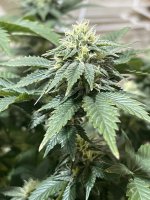
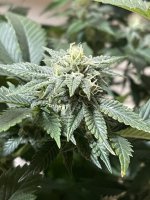
set and forget view at this point and practically forget about the cuttings in a zone of over-splash light in the veg area until around day 10. That’s when I check for roots and soak any dried plugs in a root soak solution outlined above (steps 5-6). You’ll notice in the last pictures that the cuttings can be just as heathy as the day you took the cuts. This means very little shock and repair when going from cutting to veg/flower and allows you the option of keeping the rooted cuts going in the nursery tray until you’re ready for their next destination.
19. With all of the intended cuttings complete, arrange them in your nursery tray so that there is equal spacing between them.
20. Place the humidity dome over the tray with vents closed.
21. Using your marker, write the date on the humidity dome so that you have a quick reference for when the clones were taken (this can be removed with rubbing alcohol later).
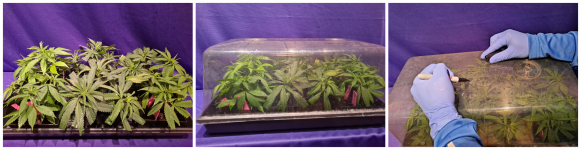
22. Place your domed tray of clones somewhere that offers
some light. I use the peripheral veg lighting by just placing the tray off to the side of my veg space. You can use a dedicated space with its own light but I opt for easiest method that utilizes what’s already available.
23. I forget about the clones for about 7-10days before checking on them. This part of the process is the result of many rounds of clones, so if you’re trying this method for the first time, it’s ok to check on them as often as you’d like.
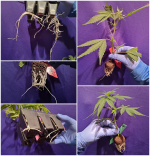
24. At between 10-15days, roots are visibly pushing through the plugs. Some vigorous cuts will have lots of roots pushing through the holes of the cell trays.
25. Transplant your rooted cuttings to whatever your desired next step or keep the cuttings going by adding a weak nutrient solution to the bottom of the nursery tray until you decide.
This is my standard cloning procedure. If you have found that using heat mats with dedicated lighting spaces etc. works well but could be better, just incorporate the bleach soak portion of this process. There's plenty of room for blending different cloning methods or steps into the use of bleach while dialing in optimum root rates for your specific environment and situation.